

The book
Chapter 5: The Serviceable Mask: Navigating Commerce in Superposition
Wearing our roles in the workplace with the clarity of an oscilloscope faceplate, without selling our inner life.
5.1 The Fluorescent Crucible: From the Desert Playa to the Industrial Bench
It is comparatively easy to feel like an unbroken node of the cosmos while sitting alone under the stars in a desert wash or tracing reaction arrows across a pad of motel stationery at midnight. In solitude, the boundary conditions of the mind are soft. No one interrupts your internal rhythm to ask why the third-quarter quality-control assays are four hours late; no telephone rings on your desk demanding an explanation for a customer’s rejected shipment; no domestic partner stands in the doorway holding an overdue utility notice while you are halfway through a contemplation of the Saundarya Laharī.
The true proving ground of non-dual field mechanics is not the hermitage. It is the ordinary weekday workplace—under forty-watt cool-white fluorescent tubes, surrounded by stainless-steel homogenizers, clipboard schedules, commercial contracts, and colleagues who have zero interest in your metaphysical vocabulary.
When our chemist returned from the desert and took up his post in an industrial food and flavor formulation laboratory, he entered the exact arena where most modern seekers admit defeat. Look around any technical enterprise in 1978. On one side of the hallway, you see the hardened company man who has completely surrendered his inwardness to the corporate machine: he treats his job title as his immortal svabhāva (intrinsic essence), measures his human worth by his departmental budget, and lives in perpetual, ulcerating terror of being proven wrong in front of his superiors. On the other side of the hallway, you see the reluctant "spiritual intellectual" who secretly despises the laboratory that pays his wages: he glides through the building with a faint, superior smile, treating his technical tasks as beneath his cosmic dignity, resenting every deadline, and dreaming of the day when he will have enough money saved to never work for a client again.
Notice that both men are trapped in the exact same dualistic hallucination. Both assume that the industrial laboratory and the unconditioned awareness are rival kingdoms at war. The company man chooses the outer ring () and starves the inner loop (); the reluctant mystic clings to an imaginary inner sanctuary () and treats the outer ring () as a prison sentence.
What happens when a practitioner refuses both halves of that delusion? What does it look like when the supertoroid—the concurrent circulation of quiet, ungrasping presence and rigorous, accountable commercial service—is brought straight onto the floor of an industrial laboratory? Let us examine the third case study from our chemist’s files: the Wednesday afternoon crisis of the thin-tasting powder.
5.2 The Alchemist in the Corporate Laboratory: The Parable of the Thin Powder
Early on a Monday morning, the laboratory received an urgent complaint from a major institutional food client. A high-volume powdered food beverage mix—a complex spray-dried emulsion of proteins, carbohydrates, vegetable lipids, and trace volatile flavor compounds—had begun exhibiting a baffling sensory defect in recent pilot runs. The client’s tasting panel reported that the reconstituted beverage tasted "thin," flat, and slightly chalky on the palate, lacking the full, rounded mouthfeel and aromatic release of the standard reference batch.
Yet when the analytical quality-control sheet arrived on our chemist’s desk, every single chemical component was present within strict specification. Gas-liquid chromatography confirmed that the trace volatile esters, aldehydes, and lactones had not evaporated; Kjeldahl nitrogen and Karl Fischer moisture titrations showed the exact target protein and water percentages; ash and fat extractions were dead on the mark. No ingredient was missing.
The laboratory director walked into the chemist’s bay on Monday afternoon and laid down the boundary condition: the client’s production line was waiting, and the company needed a verified technical explanation and corrective protocol before five o’clock on Friday.
Watch carefully how the chemist’s nervous system responded over the first forty-eight hours—Monday afternoon through Wednesday noon. Despite his two thousand miles in the culverts of 1972 and his three days in the desert motel in 1975, the habitual reflex of the "brilliant specialist" seized the wheel. Confronted with a baffling physical paradox and a ticking clock, his internal magnetic field twisted into high-energy local turbulence ().
Between Monday afternoon and Wednesday at two o’clock, he designed and executed six successive chemical modifications to the formula, each one more theoretically ingenious than the last:
1. He suspected trace oxidative degradation of an unsaturated aldehyde during homogenization and added a chelated tocopherol antioxidant package.
2. He hypothesized a shift in the hydrophilic-lipophilic balance (HLB) of the emulsifier system and substituted a twin-tailed mono-diglyceride blend.
3. He adjusted the ionic strength of the aqueous slurry prior to spray-drying using potassium citrate buffers to alter protein folding.
4. He spiked the volatile top-note package by fifteen percent to brute-force the aromatic release over the threshold.
5. He altered the maltodextrin dextrose-equivalence (DE) ratio to change glass-transition encapsulation kinetics.
6. He modified the inlet/outlet temperature differential on the laboratory pilot spray-dryer.
By three o’clock on Wednesday afternoon, when the sixth trial powder was reconstituted in warm water and tasted beside the control, the result was unmistakable: the flavor was still thin, skewed, and unnatural. Worse still, a telltale psychological symptom had appeared inside the chemist’s chest: he had begun to personally resent the powder for failing to appreciate the brilliance of his adjustments!
Every working scientist, engineer, carpenter, and writer knows that exact flavor of Wednesday-afternoon resentment. When you start feeling angry at an inanimate white powder—or at a piece of computer code, or a carburetor, or a balance sheet—what is actually happening in the cybernetic loop?
You have ceased listening to the phenomenon as it actually is (yathābhūtam), and instead you have turned the bench into a courtroom where your private ego (svabhāva) is on trial. You are no longer asking the powder, "What are your conditions?" You are shouting at the powder, "Confirm my hypothesis so that I can look like a genius on Friday!" In Ashby’s terms, the internal noise of the regulator’s self-defense has completely swamped the signal channel coming from the sample.
At three-fifteen on Wednesday afternoon, before weighing out a seventh frantic modification, the chemist noticed the constriction in his throat. He put down his stainless-steel spatula, walked out of the bright laboratory bay, pushed open the heavy fire door of the raw-material storeroom, and sat down on a wooden crate between fifty-pound fiber drums of spray-dried maltodextrin and gum arabic.
5.3 The Storeroom Stool: Superinserting the Poloidal Turn ($\theta$)
Inside the windowless storeroom, the air smelled faintly of vanilla bean extract, cardboard, and dry cornstarch. The fluorescent ballast overhead hummed at sixty cycles per second.
For fifteen minutes, sitting upright on the wooden crate with his hands resting loosely on his knees, the chemist practiced toroidal superinsertion at the level of immediate attention.
Let us be extraordinarily clear about what he did not do on that crate:
He did not close his eyes and ask the Cosmic Mind or the Goddess Tripurasundarī to telepathically whisper a secret molecular formula into his ear.
He did not attempt to visualize the chemical bonds of the food powder glowing with etheric light.
He did not try to convince himself that the client’s Friday deadline was an illusion of māyā that didn't matter.
Instead, he simply allowed the argument in his head to stop rehearsing its defense.
Recall our coupled dynamical equations from Chapter 2:
From Monday afternoon until Wednesday at three o’clock, the macro-workflow had been running uncoupled () under high external forcing (the Friday deadline). Each failed trial had fed positive-feedback frustration back into the chemist’s hypothesis generator, narrowing his cognitive aperture around increasingly exotic chemical additives.
By sitting quietly on the storeroom crate and dropping the internal defense attorney—holding the universe concise for fifteen minutes—he activated the orthogonal poloidal circulation . In the language of J. B. Taylor’s 1974 plasma relaxation theorem, he allowed the fine-scale resistive turbulence of his wounded professional pride () to dissipate as harmless heat into the quiet room, while keeping his global commitment to solving the client’s actual problem () intact. The cross-field Lorentz stress () between what he wished the problem were and what the problem actually was relaxed to zero.
When fifteen minutes had passed, he stood up, walked back through the fire door into the laboratory, and did something he had been too proud and too hurried to do on Monday: he picked up the junior technician’s raw bench notebook and read the batch preparation logs from the very first line.
There, on page two of the technician’s handwritten log, sat an observation so ordinary, so pedestrian, that it was almost insulting to a Ph.D. chemist’s vanity:
The troublesome pilot batches had not all been mixed in the same sequential order.
Specifically, in the standard reference runs, the trace volatile flavor oils had been pre-dispersed into the liquid lipid phase before the lipid was homogenized into the aqueous carbohydrate-protein slurry. In the troublesome pilot runs, to save ten minutes of vessel cleaning between shifts, an operator had dumped the dry carbohydrate carrier and protein into the water first, added the bulk oil second, and piped the trace flavor volatiles directly into the high-shear aqueous vortex last—where the amphiphilic protein tails had bound the aldehydes irreversibly before the lipid droplets could encapsulate them!
The stoichiometry was identical; the analytical assay was identical; the physical path through state-space (the order of addition) had changed!
Look at the methodological purity of what followed. Did the chemist run into the director’s office proclaiming that meditation had revealed the secret of the powder? No! Quiet sitting in a storeroom is not an analytical instrument; it is a way of clearing the lens so that you can use your analytical instruments honestly.
He walked over to the junior technician, pointed calmly to the mixing log without a trace of blame, and asked her to prepare four matched two-kilogram pilot batches under strictly controlled conditions: two following Sequence A (lipid pre-dispersion) and two following Sequence B (late aqueous addition), holding every temperature, shear rate, and ingredient weight constant. When the four powders emerged from the spray-dryer on Thursday morning, they placed them into blind, three-digit-coded cups. They ran a randomized triangle sensory test with six panelists without looking at the labels, decoded the key, and repeated the blind comparison on Thursday afternoon.
The organoleptic difference reproduced with one hundred percent fidelity: wherever the order of addition departed from lipid pre-dispersion, the flavor collapsed into thinness; wherever the original order was restored, the full aromatic profile returned.
5.4 The Bus Ride Home: Sanctifying Nothing, Completing Everything
On Friday morning, seven hours ahead of the deadline, the chemist typed up his formal technical report for the client and the laboratory director.
Inspect that report line by line. It contained no mention of Nāgārjuna, no quotation from the Saundarya Laharī, no sketch of a nested supertoroid, and no autobiographical confession about sitting on a crate in the storeroom. It stated the physical hypothesis (competitive protein-volatile binding driven by order of addition), presented the matched preparation tables, listed the blind triangle-test statistical significance (), noted the remaining boundary uncertainties regarding large-scale tank impellers, and specified the exact standard operating procedure for Monday morning’s factory run.
At four-thirty that afternoon, having delivered the report, the chemist filled out his time-sheet and submitted his consulting invoice to the accounting office. Notice how Nāgārjuna’s Two Truths (saṃvṛti-satya and paramārtha-satya) converged at the tip of his pen as he signed the invoice:
The dollar amount on the invoice was neither a shameful confession of spiritual failure nor a triumphant certificate of enlightenment. It was simply the agreed conventional price for useful work that other human beings could examine, test, and rely upon.
At five-fifteen, carrying his canvas briefcase, he climbed aboard the municipal bus to ride home across town. Sitting by the scarred aluminum window as the bus lurched through Friday rush-hour traffic past neon liquor signs, brake shops, and corner groceries, he felt the old, familiar ascetic reflex stir one last time in his chest: a quiet wish to become someone so pure, so detached, that he no longer needed money at all.
He did not fight the wish; he simply looked at it in the light of the extended cybernetic circuit. And as he looked out the bus window, he remembered the junior technician who had stayed late on Thursday to code the blind tasting cups—her monthly rent and her child’s shoes paid by the revenue of the laboratory. He remembered the warehouseman unloading the maltodextrin drums, the municipal utility workers maintaining the power lines that spun the homogenizers, and the bag of fresh groceries waiting to be bought at the neighborhood market before he walked through his own front door.
Suddenly, the ascetic wish to be "above money" revealed itself for what it truly was: a disguised wish to sever his reciprocity with those lives. The wish loosened and dissolved into the hum of the diesel engine. He realized that he did not need to sanctify the commercial transaction with spiritual perfume; he simply needed to complete it fairly.
We can map the complete cybernetic loop of the corporate laboratory across six functional stages—noting carefully that these arrows represent vulnerable, contingent human relationships requiring continuous honesty, not a magical perpetual-motion machine guaranteed against error:
That evening at seven o’clock, standing at his kitchen sink with his sleeves rolled up, the chemist was washing a cast-iron frying pan in warm, soapy water while his companion leaned against the counter telling him about a difficult conversation she had navigated during her own day. Halfway through rinsing the pan, an uninvited corollary regarding impeller shear-rates in Monday’s factory scale-up flashed across his visual cortex.
Five years earlier, he would have either let his eyes glaze over while nodding dishonestly at his companion—mentally disappearing into the factory tank while his body stood at the sink—or he would have interrupted her mid-sentence to lecture her on fluid dynamics. Instead, he dried his right hand on a dish towel, picked up a two-inch scrap of paper and a pencil stub kept beside the salt shaker for that exact purpose, jotted three words ("check impeller tip-speed"), set the pencil down, and returned his full, undivided attention to her voice and her face.
The laboratory and the kitchen sink were no longer competing for possession of an imaginary proprietor. Both were held cleanly inside the same undivided life.
5.5 Internal Neural Hyper-Divergence and Ashby’s Law of Requisite Variety
To understand why that two-inch scrap of paper beside the kitchen sink is a piece of high-precision cybernetic engineering, we must now examine the fourth case study in our dossier: the problem of the high-variety nervous system and the Mask of Serviceability.
In our seminars and laboratories, we frequently encounter a distinct human phenotype—a cognitive constitution that we may call internal neural hyper-divergence (or high-parallelism). (As a 1978 systems treatise, we use this descriptive cybernetic phrase rather than clinical psychiatric labels, viewing it as an architecture of signal processing rather than a moral defect.)
Open the private research notebooks of our chemist from any year between 1970 and 1978, and you are struck by a sobering structural fact: his notebooks contained ten times more brilliant beginnings than his mortal days could ever hold.
When a colleague stood at his desk describing a single analytical problem, the chemist’s internal network did not march down a single serial track (). Instead, before the colleague had finished his second sentence, three distinct, fully formed mechanistic explanations branched simultaneously in the chemist’s head, each demanding its own separate apparatus, reagent list, and six-week experimental timeline!
In the language of Chapter 2’s field mechanics, such a nervous system possesses an extraordinarily high internal poloidal circulation rate () coupled to rapid, spontaneous secondary loop generation (). When an interesting anomaly caught his eye at four o’clock in the afternoon, he could drop into hyper-focused flow, track the problem through thirty journal articles and four bench titrations until three o’clock in the morning—and then sleep right through an ordinary nine-o’clock dentist appointment or a promised breakfast with a friend the next morning!
Look at the social feedback generated by this neural architecture:
People praised the first habit (the midnight genius) and deeply distrusted the second (the forgotten morning promise). Yet the chemist felt in his bones that both habits belonged to the exact same crowded internal workshop.
For the first thirty years of his life, whenever the chemist forgot an appointment, left a project half-finished, or overwhelmed a colleague by answering a simple yes-or-no question with a twenty-minute lecture on non-equilibrium thermodynamics, he tried to repair the social damage by becoming more impressive. He reasoned: If I can just produce a sufficiently dazzling chemical breakthrough on Thursday, people will forgive me for being illegible, erratic, and unreachable on Tuesday!
Eventually, through the quiet feedback of those he loved and the study of W. Ross Ashby’s An Introduction to Cybernetics (1956), he realized that trying to cure unreliability with brilliance is a catastrophic category error. He did not need to become more impressive; he needed to become more legible.
Let us derive this principle using Ashby’s Law of Requisite Variety. Suppose the chemist’s internal cognitive workshop generates a massive variety of ideas, tangents, and state transitions per hour, denoted in logarithmic information measure as . Meanwhile, the shared interpersonal environment —comprising his laboratory technician, his business clients, and his household companion—operates on a finite, cooperative bandwidth that requires predictable coordination (knowing whether a test will be done by Friday, knowing who is buying groceries at six o’clock, receiving a clear answer to a direct question).
When and the internal workshop is wired directly to the outside world without an intermediate buffer or regulator , the excess variety of the internal workshop spills out into the shared life as behavioral noise: broken promises, forty half-open notebooks, unreturned phone calls, and defensive monologues.
How does Ashby’s cybernetics solve an impedance mismatch between a high-variety source and a low-variety cooperative channel? Not by smashing the internal workshop with a hammer, and not by demanding that the rest of humanity rewire their nervous systems to match your chaos! You solve it by designing an externalized regulatory interface that filters, selects, and translates the internal variety into stable, high-integrity signals before commitments are made:
1. Externalizing Memory onto Visible Media: Instead of trusting a hyper-divergent cerebral cortex—which will trade a grocery list for an alkaloid synthesis inside of ten seconds—to hold temporal appointments in working memory, you transfer the regulatory burden onto physical structures outside the skull. The chemist began carrying a single small ledger in his shirt pocket and writing down every promise before allowing his mouth to speak a new one. At home, he hung a large weekly calendar on the kitchen wall where his companion could see it at a glance.
2. Pre-Negotiated Solitude Boundaries: Instead of vanishing unannounced into a mental culvert in the middle of a domestic evening, he learned to ask explicitly for an hour of quiet solitude behind a closed study door—without pretending that his need for quiet was a superior spiritual verdict on the people he loved.
3. Reducing Decision Load at Fatigue Hours: Recognizing that regulatory capacity () drops sharply when blood glucose and neural glycogen are depleted at the end of the workday, he simplified his routines so that fewer structural decisions were left to the hour when he was least able to make them.
5.6 The Oscilloscope Faceplate: Reframing the "Ego Mask" as an Impedance-Matching Ring
This brings us to one of the most liberating psychological reversals in our entire treatise: the true nature of the social and professional persona.
In the raw, confrontational encounter groups that became popular across California in the late 1960s and early 1970s, the word "mask" became the ultimate term of abuse. Participants were exhorted to "rip off their social masks," abandon polite professional manners, and let their raw, unfiltered interiority pour out onto the rug at every moment. Consequently, when our chemist sat in a corporate conference room wearing a clean collared shirt, speaking in measured technical sentences, and sticking to the client’s agenda while holding vast, non-dual silence inside his chest, he initially suffered pangs of spiritual impostor syndrome. He called his professional manner a "mask," and for several years this made him feel subtly fraudulent—as though he were a stage actor hiding his real face from the world.
Then, one Tuesday morning in the instrumentation bay, he stood looking at the front panel of a Tektronix cathode-ray oscilloscope on his bench.
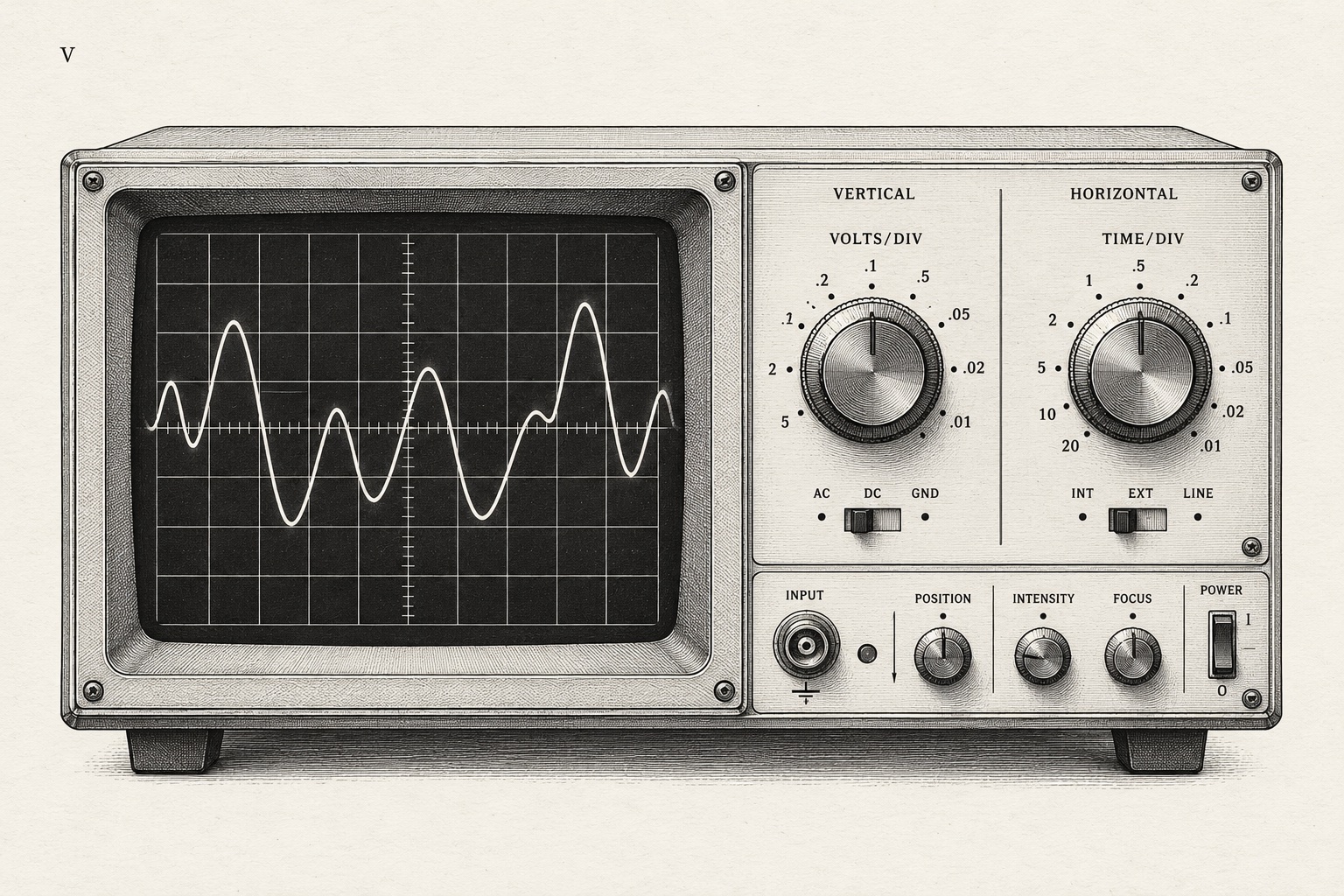
Inside the perforated aluminum chassis of that oscilloscope lay a bewildering jungle of high-voltage step-up transformers, glowing vacuum tubes and transistor arrays, electrolytic filter capacitors charged to four hundred volts, resistor ladders, and tangled wiring harnesses carrying microsecond sawtooth sweeps.
Yet on the front of the chassis sat a calm, brushed-aluminum faceplate. On that faceplate were a green phosphor graticule screen and six clearly labeled rotary knobs: Vertical Volts/Div, Horizontal Time/Div, Trigger Level, Intensity, Focus, and Position.
The chemist looked at the faceplate and asked himself: Is the faceplate of this oscilloscope a fraudulent lie?
Of course not! The faceplate does not display every raw internal current within the case—and thank goodness it doesn't! If the manufacturer tore off the faceplate and forced the operator to reach his bare fingers straight into the four-hundred-volt anode wiring every time he wanted to measure a sine wave, the instrument would be both dangerous and useless. The faceplate displays what another person needs in order to interact with the instrument safely, clearly, and responsibly.
In electrical engineering, when you connect a high-internal-impedance source () to an external load (), maximum clean power transfer without destructive signal reflection requires inserting an impedance-matching network between them. That is the exact physical definition of a healthy social and professional persona:
The serviceable mask is not a false identity hiding a metaphysically superior "true self" behind a curtain. It is an outer impedance-matching ring designed to keep a complex, high-frequency organism legible, safe, and serviceable to clients, colleagues, and loved ones.
When does an instrument’s faceplate become deceptive or fraudulent? Only when its markings are false! If the dial on the front of the oscilloscope is painted to read "1 Volt per Division" when the internal attenuator is actually delivering fifty volts, or if the box is empty inside, then the faceplate is a lie. Similarly, if a consultant uses a smooth professional manner to promise an assay he knows he cannot perform, or to feign affection he does not feel, the mask is corrupt.
But when the markings on the faceplate correspond honestly to the capabilities and limits of the workshop inside—"I can deliver the order-of-addition trials by Thursday noon; I need forty-five minutes of quiet after dinner before we go over the household accounts; I do not know the answer to Step 3 yet, and here is how I will test it"—then the faceplate is an instrument of pure integrity.
5.7 The Final Ontological Correction: When the Mask Sticks
Here we must apply Nāgārjuna’s scalpel one last time to correct an insidious trap in how contemplatives talk about the mask.
When a practitioner first discovers that he can hold silent non-dual awareness inside while operating a clean professional interface outside, he is often tempted to describe his situation like this: "On the outside, I wear a conventional ego mask to deal with the ordinary people in the marketplace; on the inside, I am the Immortal Witness holding the universe concise!"
While that sentence accurately captures how the practitioner initially feels during the transition from anxiety to integration, it cannot be our final ontology. Why? Because if you believe that the outer mask is "unreal" and the inner awareness is a "second, metaphysically superior person" hiding behind the mask, you have fallen right back into svabhāva dualism! You have merely installed an arrogant Spiritual Phantom in the attic of your skull who looks down his nose at his own hands and mouth.
Look at the supertoroid through the uncompromising clarity of Chapter 1:
The professional role at the conference table (saṃvṛti),
The silent, ungrasping awareness on the storeroom stool, and
The dynamic interaction between them
are all equally empty of independent self-nature (svabhāva), and are all equally functional within dependent arising (pratītyasamutpāda)!
The faceplate on the oscilloscope is not covering up a secret second person inside the metal box; the faceplate, the internal circuitry, the electric wall socket, and the engineer reading the screen are one continuous, dependent circuit.
Because there is no infallible metaphysical superman hiding inside the box, the practitioner must remain humble and alert to a very real human mechanical failure: sometimes, after a long day of high-pressure work, the professional mask sticks to the face after its usefulness has ended.
Consider a quiet scene from our chemist’s dining room on a Thursday night. He had spent six hours at the laboratory defending a complex budget and safety protocol before a skeptical corporate review board. Throughout the afternoon, the crisp, analytical faceplate had served him and his team well. At six-thirty, he walked through his front door, sat down at the dinner table across from his companion, and began to eat soup.
Across the table, she asked him a simple, affectionate question about whether he had remembered to call the plumber about the leaking porch faucet.
Instantly, without intending to, the chemist heard his own voice reply in the exact clipped, forensic, subtly condescending cadence he had used three hours earlier to dismantle a hostile question from the corporate comptroller—complete with enumerated sub-clauses and a defensive rationale for his scheduling priorities!
His companion did not argue with the brief. She simply set her spoon down beside her bowl and waited in silence.
In the cybernetics of human relationship, a partner who loves you enough to simply wait in silence when your faceplate is stuck provides the purest feedback signal on earth. The silence in the dining room acted as a mirror. Within three seconds, the chemist heard the echoing metallic clang of his own voice.
He reached up and took off his wire-rimmed spectacles, setting them on the tablecloth—even though the spectacles were hardly the source of the trouble. He let out a long breath, felt the residual Lorentz tension in his jaw dissolve, and looked at her with unadorned eyes.
"Forgive me," he said quietly. "I am still at the laboratory."
Let us honor the profound realism of that moment. The mask can serve; the mask can also stick. And learning to tell the difference in real time cannot be accomplished by retreating into an imaginary "inward infinity" where you pretend to be above human friction. Learning when to put the faceplate on and when to take it off requires another human being whom you trust to give you honest feedback, enough physical sleep to keep the regulator flexible, and the explicit permission to stop performing. No amount of facility with magnetohydrodynamic equations or Sanskrit verses exempts an embodied human being from any of those three requirements.
Above the chemist’s home desk, written in black marker on a plain three-by-five index card pinned to the bookshelf, stood three imperative verbs that governed this daily maintenance of the interface:
PURGE. MARRY. SIMPLIFY.
By purge, he meant clearing out every unfinished obligation and phantom role he had no honest intention of completing. By marry (or unify), he meant allowing his scientific work, his contemplative stillness, and his domestic affection to answer to one undivided life. By simplify, he meant leaving fewer decisions to the exhausted evening hour when the mask is most likely to stick.
We have watched the pilgrim discover support in the culverts of 1972; we have watched the inventor submit his midnight vision to falsification in the motel room of 1975; and we have watched the corporate alchemist join storeroom stillness to accountable work and a humane interface. It remains now, in our sixth and final chapter, to assemble these operational lessons into a complete, practical manual for continuous free flow.
<!-- PASTE BATCH 3 (INSTALLMENTS 6 & 7) BELOW THIS LINE -->
Chapter companion
Chapter 5 addresses a question every practitioner faces: how do we earn a living and hold responsibilities inside imperfect institutions without either becoming cynical phonies or demanding that every coworker listen to our spiritual autobiography? Through the image of the brushed-aluminum faceplate on an oscilloscope, the chapter teaches the art of the serviceable mask: offering others a clear, honest, reliable interface while keeping our deepest freedom intact.
Core teachings
- A clear professional or social role is an act of courtesy that lets other people cooperate with us safely.
- Like an instrument’s faceplate, a good role translates complex inner work into honest signals without pretending to be the whole person.
- Speaking in language our colleagues and neighbors can actually use is a form of generosity, not a betrayal of depth.
- A mask stays healthy only when we can take it off at the end of the shift and rest.
- Clarity at work never means silence in the face of dishonesty or harm.
In ordinary life
When a nurse, engineer, or teacher gives a colleague a crisp, honest handoff note at the end of a shift (what was done, what is still uncertain, and what needs watching), that plainness is contemplative care in action.
Where to test this
Talk of 'impedance matching' in the workplace can easily be misused to preach quiet compliance with an exploitative boss or a dishonest company. In the Toroidal Way, a serviceable mask never tells a lie and never takes away your freedom to speak up or walk out.
Sources and scope
The oscilloscope faceplate and electrical impedance are engineering analogies that illuminate social cooperation; human beings remain moral agents, never circuit components.
Questions for reflection
- Which of your daily roles helps other people trust and work with you, and which role has started to feel like a cage?
- How can you make your promises clearer this week without performing busyness?
- What helps you set your work role down when you walk through your front door?